
The Decoding-Comprehension Disconnect: Hyperlexia in Autism


For many autistic people, the written word is a safe haven. Letters follow predictable rules. Phonics make logical sense. This intense affinity for text often manifests early in childhood as hyperlexia, a fascinating and frequently misunderstood neurodivergent trait.
While hyperlexia is often celebrated as an early sign of “genius,” the reality of living with it is far more complex. In 2009, researchers Huemer and Mann highlighted the defining characteristic of this profile: a striking gap between advanced word decoding skills and significantly weaker reading comprehension.
When educators and society misunderstand this disconnect, it sets the stage for a lifetime of academic gaslighting and profound autistic burnout.
The Mechanics: Decoding vs. Comprehension
To understand hyperlexia, we have to separate reading into two distinct mechanical processes. Autistic brains often excel at one while struggling deeply with the other.
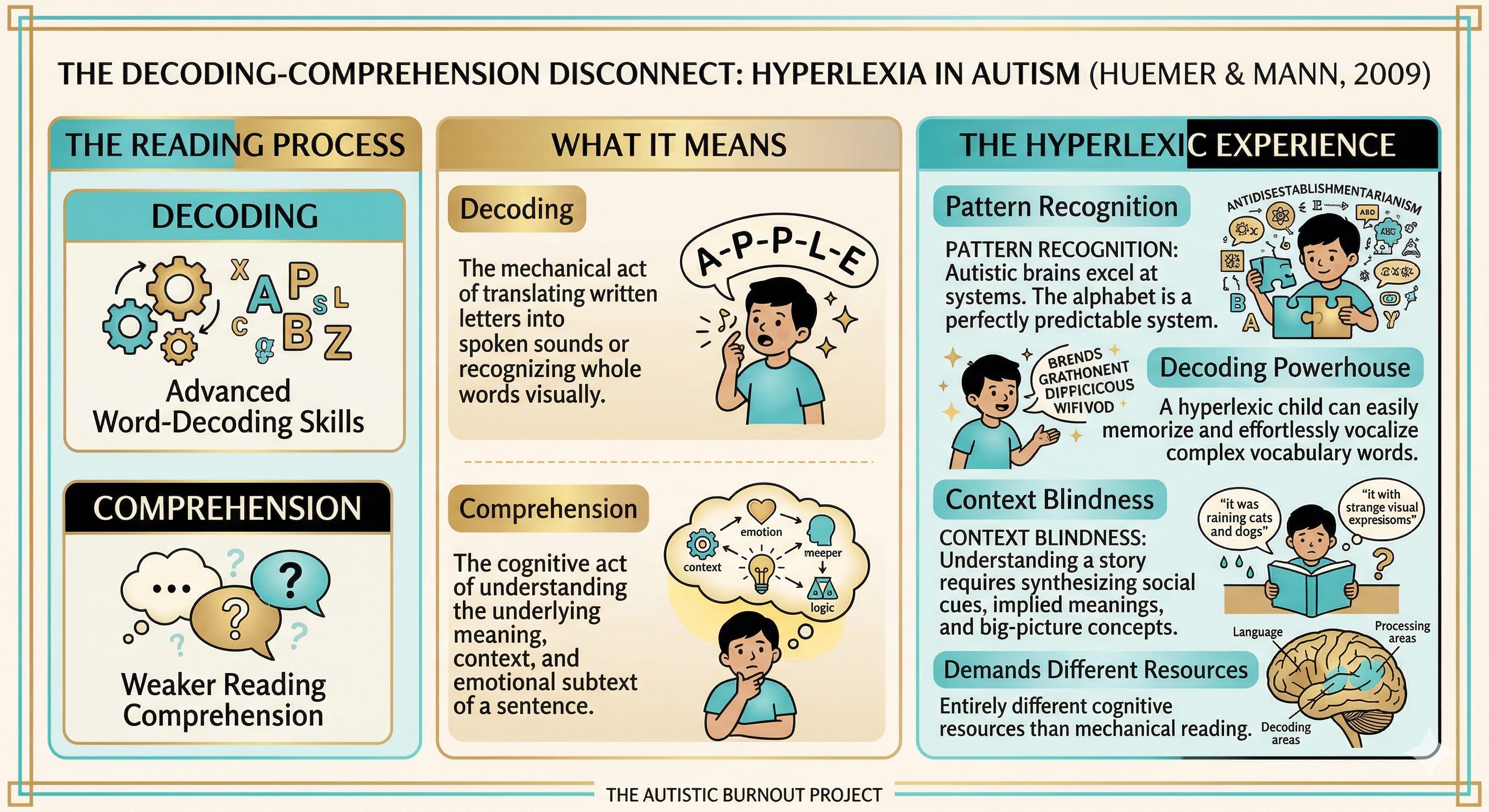
An autistic child might fluently read a college-level sentence about geopolitical conflicts aloud with perfect pronunciation. However, if you ask them what the sentence actually meant, they might not be able to tell you. They are reading the “data” of the letters, but the “story” behind the data remains untranslated.
The Root of the Disconnect
Why does an autistic brain process text this way? It comes down to how we process the world around us.
Bottom-Up Processing: Neurotypical brains tend to be top-down processors. They look at the big picture first and fill in the details later. Autistic brains are bottom-up processors. We see every individual leaf before we realize we are looking at a forest. In reading, this means we hyper-focus on the structure of individual words rather than the overarching narrative.
Literal Interpretation: Comprehension often requires “reading between the lines.” If a story says “it was raining cats and dogs,” a decoding brain processes the literal animals, causing massive confusion about the context of the weather.
Monotropic Focus: Hyperlexia is often driven by an intense, monotropic special interest in letters and fonts. The joy comes from identifying the symbols themselves, not necessarily the stories those symbols are trying to tell.
How the Disconnect Fuels Autistic Burnout
The hyperlexic profile is a perfect storm for invisible burnout.
When a child enters school reading years ahead of their peers, teachers instantly categorize them as “gifted” and “low support needs.” The adult world assumes that if you can read complex instructions, you can automatically understand and execute them.
When the hyperlexic student inevitably fails to grasp the implied meaning of an assignment, follow multi-step written directions, or understand the social dynamics in a novel, they are rarely offered support. Instead, they are met with accusations. They are told they are “not trying hard enough,” “being lazy,” or “acting out.”
This is the core tragedy of the decoding-comprehension disconnect. The autistic person is forced to constantly mask their genuine confusion because their mechanical reading skills have set an impossibly high, neuro-normative standard for their overall cognitive abilities.
Validating the Hyperlexic Experience
The Autistic Burnout Project believes that recognizing hyperlexia accurately is a vital step in preventing burnout.
Having splintered skills is a completely natural part of the autistic experience. Being able to decode the dictionary at age five does not invalidate your need for clear, literal instructions and contextual support at age twenty-five. We must stop demanding that our mechanical abilities match our processing speeds, and start honoring the unique, complex ways our brains interact with the world.